Showing posts with label lunar new year. Show all posts

Friday, 18 May 2012

Hello and welcome to the latest posting from Innersound Ancestry.
 Today I am continuing with the second part of my explanation of the Korean cultural practise of respecting ancestors through ceremonial rites.
All the major ceremonies throughout the Korean calendar have a strong element of ancestral veneration.
The picture below shows food offered during an ancestral ceremony at the start of the lunar new year festival.
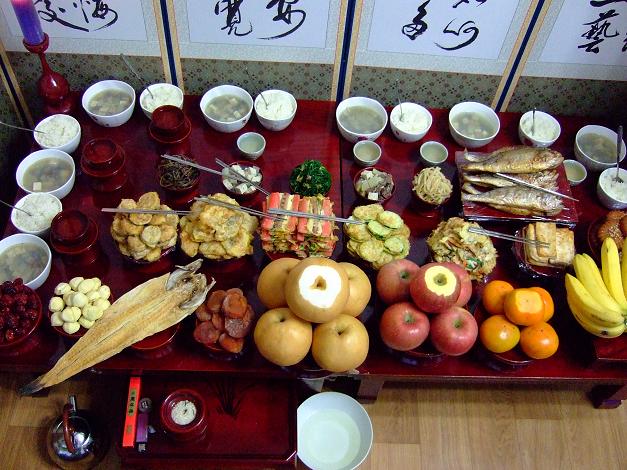
 
The picture above shows traditional Korean foods that are offered for ceremony. It is important to offer fish, meat and vegetables for ceremony. The women in a Korean household prepare the food while the men will perform the ceremonial rites.
The confuscian influence on korean society places great importance on making harmony. Harmony for Confuscians is created by having responsibility for one's relations with others.Husband and wife, parent and child etc. one's duty in these relationships is emphasised in confuscian thought. Therefore hierachy is also very important.Elders are greatly respected. This is reflected in the fact that food is offered to the ancestors first before anyone else can eat. Next the eldest men will be served, then women and the children last.
The day before the ceremony the women in a Korean household will cook traditional foods for the ceremony.
This will include ”  Korean dumplings known as“mandu" in Korean ,   pan fried food known as “jeon”,
  rice cakes called “tteok” and side dishes called “banchan”. Early in the morning of the Lunar New Year the food will be set up on wooden stands called "jegi" and placed on the ceremonial table . The men of the household will place spoons in the rice bowls to offer the food to the ancestors and wine or "sul" will be served in a style similar to a Japanese tea ceremony. After the offerings have been made a piece of paper with the ancestors names written on is burnt.
When the ceremony is finished the children of the household will bow to their elders and receive money frothe new year known as "sebe ton".

Wednesday, 16 May 2012

Hello and welcome to the latest Innersound Ancestry posting.

Today I am going to start looking at examples from around the world of the practise of respect for ancestors . Innersound Ancestry has it's roots in Korea so my first point of call is therefore the Korean peninsula.

Korean culture is steeped in Taoist, Confuscian and Buddhist tradition. During the year there are several big celebrations/ceremonies that happen throughout the country. The biggest of these is the lunar new year ceremony which happens usually in the month of February. The dates vary in the western calendar  as in the west we follow a solar calendar and Korean ceremonies follow the lunar calendar. People usually refer to the lunar new year as the Chinese new year but if you don't wish to offend Easterners who are not from China it is more polite and more accurate to refer to it as the Lunar New Year.
At Innersound Ancestry we also celebrate these occasions in a similar fashion to the way it is conducted on the Korean peninsula. Lunar new year ceremony is known as 'seol nal' in Korea and is one of the two biggest holidays of the year. The other big ceremony is Chuseok which is held on the 15th of the 8th month of the lunar calendar which is harvest time.
For both of these holidays food and wine is offered to ancestral spirits during what is known as 'cha-rye' or ancestral rite. The picture above shows a  typical offerings for 'cha-rye'. Food and wine are offered to the ancestors. This will include meat and fish, rice and soup and many side dishes. Rice cake, red dates and dried persimmon are also delicacies which are offered to the ancestors.There are certain foods that are forbidden for ceremonies such as spicy food and peaches.
The names of the deceased ancestors are written on the wooden tablets at the back of the table.
the women in a korean household will cook the day before a big celebration day so that the cha-rye can be held early in the morning. After the food has been offered to the ancestors the descendants will eat the ceremony food.

More on Korean culture and Ancestral rites next time.

regards,

Innersound Ancestry Team